
Gearbox for Mining Conveyors
- Typical equipment: Belt and screw conveyors
- Drive arrangement: space-efficient parallel-shaft arrangement
- Environment: dust, vibration and load changes
Recommended gearbox families

F Series Parallel Shaft Helical Gearbox
F series parallel-shaft gearbox example

K Series Helical-Bevel Gearbox
K series gearbox-and-motor assembly example

R Series Helical Inline Gearbox
R series inline gearbox-and-motor example

Cycloidal (Pin Gear) Speed Reducer
Horizontal cycloidal reducer example
Selection conditions
An F Series Parallel Shaft Helical Gearbox is a natural candidate for belt and screw conveyors where high torque and a space-efficient parallel-shaft arrangement are required. Its layout can fit close to the conveyor structure without forcing a long inline installation.
For right-angle drives, inclined conveyors and heavier material-handling equipment, a K Series Helical-Bevel Gearbox should be evaluated. Its configuration is appropriate where torque demand and shaft direction make a worm gearbox an unsuitable shortcut.
An R Series Helical Inline Gearbox can serve conveyors, fans and process-line equipment with a conventional coaxial layout and continuous-duty efficiency requirements. For feeders, screens or auxiliary machines exposed to shock, a Cycloidal (Pin Gear) Speed Reducer is worth considering because compact high-ratio transmission and overload resistance are useful in fluctuating service.
Other layouts to review
An S Series Helical-Worm Gearbox may be relevant to smaller lifting or positioning duties where a right-angle layout and load-holding tendency are desired. A separate brake or backstop must be specified whenever uncontrolled reverse movement creates a safety or equipment risk. WP Series Cast Iron Worm Gearbox units can support selected intermittent auxiliary duties, but thermal capacity must be checked before continuous use.
For the layouts discussed above, review F Series parallel-shaft gear units, K Series helical-bevel gear units and R Series inline helical gear units. Confirm loaded starts, peak torque and run time before choosing a configuration.
Mining and metallurgical equipment operates under dust, vibration and load changes that quickly expose a weak drive selection. Belt conveyors start with material on the belt, bucket elevators lift a sustained vertical load, and screening or crushing auxiliaries transmit vibration through the supporting structure. A reducer that works in a clean workshop may have a much shorter life when seals, bearings and mounting are subjected to these conditions every day.
The correct selection begins with the real operating profile: starting condition, loaded starts, peak torque, run time, incline, material density and the consequences of a stopped line. Site altitude, temperature and dust control can also affect thermal performance and maintenance planning. Motor power alone does not describe these risks.
Why standard service assumptions are insufficient
Conveyor loads change with feed rate and material buildup. A jammed chute or frozen roller can create a short torque peak far above normal running torque. Bucket elevators add reverse-load and back-driving risks during a stop. Screens and crusher auxiliaries can transmit repeated impact and vibration into the gearbox mounting.
Dust is another failure path. Fine mineral particles can damage seals and contaminate lubricant, while accumulated dust reduces heat dissipation. If the gearbox is difficult to inspect, a small leak or loose mounting bolt may remain unnoticed until the line stops. The drive layout should therefore make lubrication, seal inspection and alignment checks practical.
Typical equipment
- Belt and screw conveyors
- Bucket elevators
- Feeders and transfer stations
- Screening equipment
- Small crusher auxiliary drives
- Metallurgical roller tables
- Dust collection and process fans
Information needed for this industry
Provide conveyor length, width, speed, incline, material type and bulk density, maximum throughput and loaded-start requirement. For bucket elevators include lift height, capacity and the proposed brake or backstop. Describe vibration isolation, site temperature, altitude and dust level. Use the enquiry checklist for standard motor, duty and installation fields.
Open the complete enquiry checklist.
Operating and maintenance conditions
Define the spare-part strategy, lifting access, routine inspection route and service access at the quotation stage. Include failure history and whether shock, vibration or contamination requires a change rather than only a mounting-compatible replacement. Plan lubrication, seal and alignment checks for the real site.
Final configuration requires the applicable technical data and your machine duty.
For installation evidence, use the installation photo guide.
Request an application review
New machine or no nameplate? Contact us.
FAQ
Which data is needed for a conveyor gearbox?
Provide conveyor dimensions, speed, incline, material density, throughput, loaded-start requirement, motor data and peak torque. State whether the unit drives a belt, screw, bucket elevator or another machine.
Why is a backstop or brake discussed separately?
Bucket elevators and inclined conveyors can reverse under load. The required safety and control function must be specified; it should not be assumed from a gearbox’s internal characteristics.
How does dust affect the selection?
Dust can damage seals, contaminate lubricant and reduce cooling. The site’s sealing, cleaning and inspection conditions influence service life and maintenance requirements.
What supports a replacement compatibility check?
Use the installation photo guide and include layout drawings and failure history. State whether the replacement must match the existing envelope or correct a recurring operating problem. Open the installation photo guide.
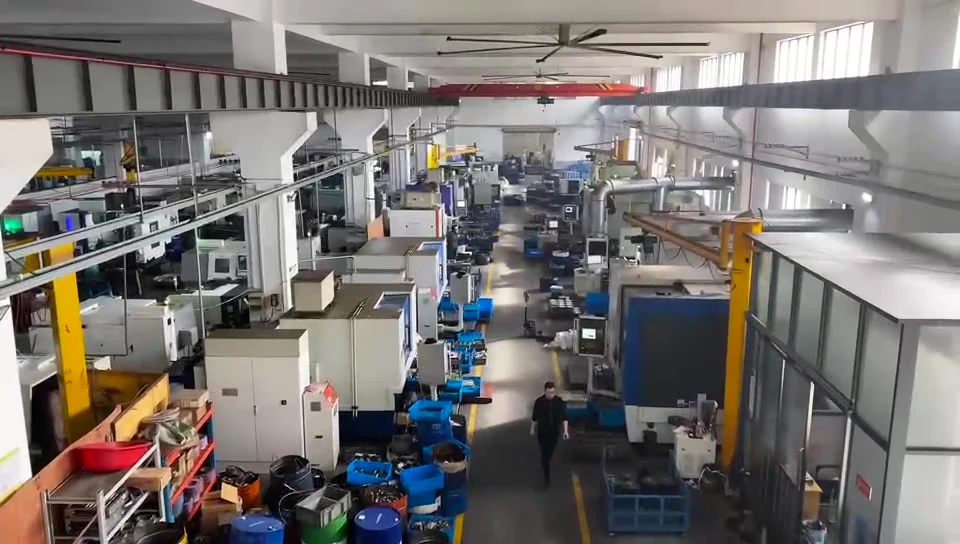
Inside the workshop
A view of the workshop. Product configuration is reviewed against your machine and application.
READY FOR A TECHNICAL REVIEW?
Send your nameplate, get a mounting review within one business day.
Or message us directly