
Gearbox for Chemical Mixers
- Typical equipment: Reactor and vessel agitators
- Drive arrangement: installation envelope is narrow or the drive must sit beside a vessel or conveyor
- Environment: exposure to chemicals, washdown, dust and ambient temperature
Recommended gearbox families

R Series Helical Inline Gearbox
R series inline gearbox-and-motor example

K Series Helical-Bevel Gearbox
K series gearbox-and-motor assembly example

F Series Parallel Shaft Helical Gearbox
F series parallel-shaft gearbox example

Cycloidal (Pin Gear) Speed Reducer
Horizontal cycloidal reducer example
Selection conditions
An R Series Helical Inline Gearbox is a strong starting point for conventional agitators and process-line drives where efficient continuous operation and a coaxial arrangement are suitable. Its layout works well when the motor and driven shaft can be aligned.
For a vertical mixer or a 90-degree shaft arrangement, a K Series Helical-Bevel Gearbox should be considered. It is better aligned with higher-torque process duties than choosing a compact worm unit simply because a right-angle output is required.
An F Series Parallel Shaft Helical Gearbox is relevant where the installation envelope is narrow or the drive must sit beside a vessel or conveyor. For kneaders, granulators and other machines with changing or shock loads, a Cycloidal (Pin Gear) Speed Reducer can be evaluated for compact high-ratio service and overload resistance.
Other layouts to review
An S Series Helical-Worm Gearbox may suit smaller mixers or positioning mechanisms that need a large ratio in a right-angle layout. WP Series Cast Iron Worm Gearbox and NMRV Aluminium Alloy Worm Gearbox units should be limited to duties where the calculated thermal load and operating schedule are acceptable. They are not the default choice for uninterrupted high-power mixing.
For the layouts discussed above, review R Series inline helical gear units, K Series helical-bevel gear units and F Series parallel-shaft gear units. Confirm running torque, startup torque and mixing profile before choosing a configuration.
Chemical-processing drives must deliver controlled low-speed torque while operating around liquids, vapours, powders and temperature changes. Reactor agitators, kneaders and granulators can place very different demands on a gearbox even when their motors have similar power. Viscosity may change during a batch, solids may settle before startup, and a mixer can experience its highest torque before the material begins to move.
The gearbox should be selected from the process duty, not from a model cross-reference alone. Required output speed, running torque, startup torque, mixing profile and shaft arrangement are essential. The process medium also matters because corrosion, washdown and hazardous-area requirements may affect the complete drive package beyond the gearbox itself.
Why catalogue-only selection is risky
A mixer normally has a variable load. During heating, cooling, reaction or concentration, the viscosity can increase and push the drive above its initial operating point. If the selection uses only nominal motor power, the gearbox may be adequate for a thin starting liquid but undersized for the later stage of the batch.
Vertical agitators add shaft and mounting questions. The gearbox output must match the driven shaft arrangement, and the support structure must handle the forces created by the mixer. Misalignment or inadequate support can overload bearings even when the transmitted torque is within range. In corrosive areas, seals, coatings, fasteners and maintenance intervals must be specified with the process owner rather than assumed.
Typical equipment
- Reactor and vessel agitators
- Vertical and side-entry mixers
- Kneaders and high-viscosity mixers
- Powder and liquid blending systems
- Granulators and pelletizing auxiliaries
- Screw feeders and transfer conveyors
- Dosing and packaging line drives
Information needed for this industry
Provide mixer type, impeller arrangement, viscosity range, batch volume, startup condition and mixing profile. State whether the output shaft is vertical and describe chemical, washdown, dust and temperature exposure. Identify the required hazardous-area standard and zone so qualified parties can review the complete motor-drive package. Use the enquiry checklist for standard motor, speed, torque and installation fields.
Open the complete enquiry checklist.
Operating and maintenance conditions
Describe whether replacement follows a process change, viscosity increase, repeated seal failure or maintenance upgrade. Keep the vessel, agitator and shaft-support arrangement in the review. Hazardous-area requirements and corrosion resistance belong to the complete drive package and require review by qualified parties before any suitability statement.
Final configuration requires the applicable technical data and your machine duty.
For installation evidence, use the installation photo guide.
Request an application review
New machine or no nameplate? Contact us.
FAQ
What mixer information is needed before gearbox selection?
Provide impeller type, shaft arrangement, material viscosity range, batch volume, motor data, output speed, normal torque and maximum startup torque. Process changes during a batch are especially relevant.
Can the gearbox be selected from a previous model number?
The previous model is useful evidence, but it is not enough. Confirm mounting, shaft loads, duty cycle and the reason for replacement before selecting an equivalent or upgraded unit.
How should corrosive service be described?
State the medium, vapour, washdown chemicals, ambient temperature and exposure frequency. This allows the buyer and engineering team to assess housing protection, seals and maintenance requirements.
Does a right-angle layout automatically require a worm gearbox?
No. A helical-bevel gearbox may be more appropriate where efficiency and torque are high. The layout is one input alongside thermal duty and actual operating load.
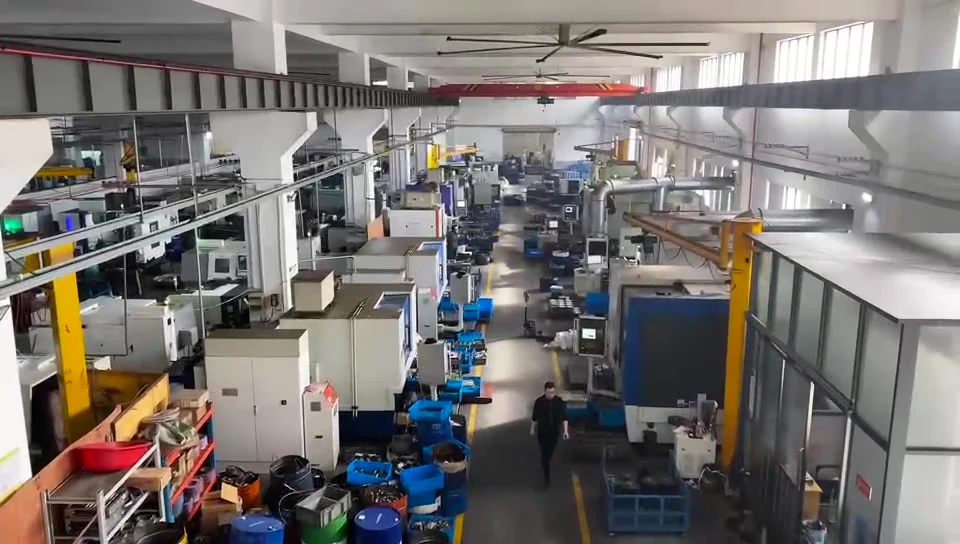
Inside the workshop
A view of the workshop. Product configuration is reviewed against your machine and application.
READY FOR A TECHNICAL REVIEW?
Send your nameplate, get a mounting review within one business day.
Or message us directly