
Gearbox for Concrete Mixers
- Typical equipment: Concrete and mortar mixers
- Drive arrangement: input and output shafts need to remain parallel
- Environment: frequent starts, abrupt load changes and persistent dust
Recommended gearbox families

K Series Helical-Bevel Gearbox
K series gearbox-and-motor assembly example

R Series Helical Inline Gearbox
R series inline gearbox-and-motor example

F Series Parallel Shaft Helical Gearbox
F series parallel-shaft gearbox example

Cycloidal (Pin Gear) Speed Reducer
Horizontal cycloidal reducer example
Selection conditions
For concrete mixers and batching equipment that need a right-angle heavy-duty drive, a K Series Helical-Bevel Gearbox is a primary candidate. Its shaft arrangement suits many mixer layouts, and it should be evaluated where a worm gearbox would not provide the required efficiency or thermal margin.
An R Series Helical Inline Gearbox works well for conveyors and auxiliary drives with a coaxial arrangement. For screw feeders and compact batching lines where the input and output shafts need to remain parallel, an F Series Parallel Shaft Helical Gearbox can offer a practical installation.
A Cycloidal (Pin Gear) Speed Reducer is relevant to mixers, feeders and other drives with repeated shock or high-ratio requirements. Its overload-resistant character can be useful, but the selection still needs the real starting and jam torque.
Other layouts to review
An S Series Helical-Worm Gearbox or WP Series Cast Iron Worm Gearbox may suit selected lifting, gate or intermittent positioning mechanisms. Any load-holding requirement must be supported by the appropriate brake or safety system. NMRV Aluminium Alloy Worm Gearbox units are intended for lighter mechanisms and should not be treated as a default drive for continuous, high-load concrete processing.
For the layouts discussed above, review K Series helical-bevel gear units, R Series inline helical gear units and F Series parallel-shaft gear units. Confirm frequent starts, abrupt load changes and persistent dust before choosing a configuration.
Concrete and construction equipment subjects gearboxes to frequent starts, abrupt load changes and persistent dust. A mixer may start with residual material in the drum, a batching conveyor may cycle many times per hour, and a screw feeder can experience a sudden jam when the material bridges. These applications need more than a ratio that produces the required output speed.
Purchasing and engineering teams should define the full operating cycle: loaded or unloaded start, mixing time, discharge time, starts per hour, peak material resistance and cleaning method. Mobile and outdoor equipment adds temperature, rain, vibration and transport shock. A gearbox selected for a steady indoor load may not tolerate this cycle.
Why a motor-power match is not enough
The highest load often occurs for only a short period. That makes it easy to overlook during a simple average-power calculation, yet repeated peaks are exactly what fatigue shafts, keys, bearings and gear teeth. A jammed screw or partially hardened mix can impose a severe overload before an operator stops the machine.
Frequent starting also generates heat. If a compact drive has limited thermal capacity, repeated cycles can raise lubricant temperature even when each individual run is short. Dust around seals and breathers increases the risk of contamination, while concrete buildup can hide leaks and make inspection difficult.
Typical equipment
- Concrete and mortar mixers
- Batching plant conveyors
- Screw feeders and screw conveyors
- Aggregate and cement dosing systems
- Hopper gates and positioning mechanisms
- Mobile construction machinery auxiliaries
- Block and precast production lines
Information needed for this industry
Provide mixer type and capacity, normal mixing torque, maximum startup or jam torque, starts per hour and batch cycle. For outdoor or mobile equipment state temperature range, weather exposure, transport vibration and cleaning practice. Use the enquiry checklist for standard motor, speed and installation fields.
Open the complete enquiry checklist.
Operating and maintenance conditions
Keep inspection covers, fasteners, seals and lubricant points reachable after concrete buildup, guards and surrounding equipment are considered. State whether replacement must fit the former envelope or address recurring jams, heat or overload. If the previous unit overheated or failed, reassess the duty rather than repeating the nominal selection.
Final configuration requires the applicable technical data and your machine duty.
For installation evidence, use the installation photo guide.
Request an application review
New machine or no nameplate? Contact us.
FAQ
Which load matters most on a concrete mixer?
Normal running torque is only one input. Loaded startup, hardened residual material, starts per hour and screw-feeder jams can determine the peak condition that drives selection.
Can a replacement gearbox use the former ratio without review?
Not automatically. The existing ratio and model help identify the installation, but a failure history or different production cycle can require a new duty calculation.
Why does frequent cycling matter?
Repeated starts increase thermal load and fatigue. A compact drive may appear adequate on one cycle yet overheat when the batch plant repeats that cycle throughout a shift.
What photos should be sent for compatibility review?
Use the installation photo guide and show guard clearance. Include evidence of oil leaks, noise or overheating to distinguish dimensional replacement from corrective selection. Open the installation photo guide.
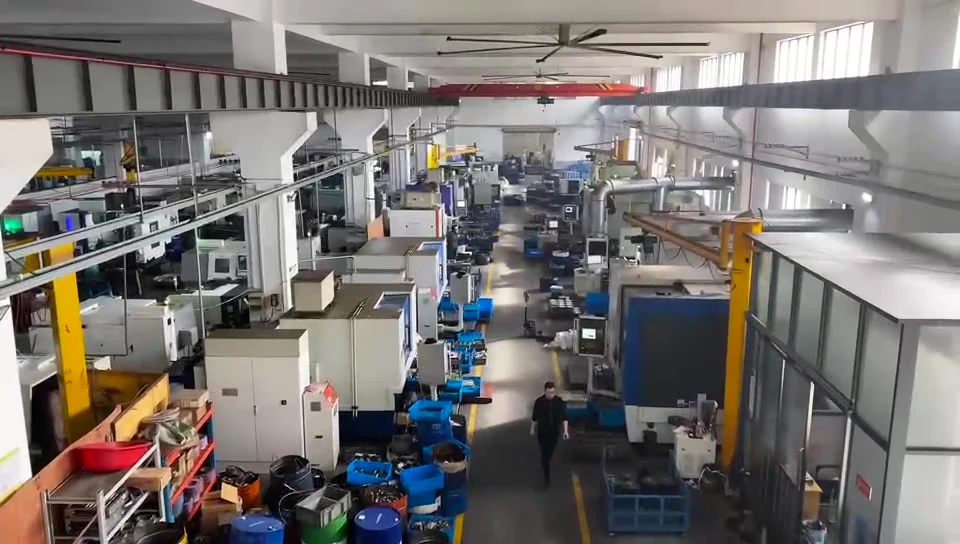
Inside the workshop
A view of the workshop. Product configuration is reviewed against your machine and application.
READY FOR A TECHNICAL REVIEW?
Send your nameplate, get a mounting review within one business day.
Or message us directly