
Gearbox for Ceramics Machinery
- Typical equipment: Ball mills and auxiliary mill drives
- Drive arrangement: restricted installation space with parallel shafts
- Environment: continuous duty, abrasive dust and changing loads
Recommended gearbox families

R Series Helical Inline Gearbox
R series inline gearbox-and-motor example

K Series Helical-Bevel Gearbox
K series gearbox-and-motor assembly example

F Series Parallel Shaft Helical Gearbox
F series parallel-shaft gearbox example

Cycloidal (Pin Gear) Speed Reducer
Horizontal cycloidal reducer example
Selection conditions
For long-running conveyors, kiln auxiliaries and process lines where efficiency is important, an R Series Helical Inline Gearbox is a practical starting point. Its coaxial layout suits many conventional drive arrangements, while helical gearing supports efficient continuous transmission.
Where the drive must turn through 90 degrees and carry a heavier load, a K Series Helical-Bevel Gearbox is usually the stronger candidate. It is relevant to vertical mixers, kiln auxiliary drives and equipment where the motor direction cannot align with the output shaft.
For restricted installation space with parallel shafts, an F Series Parallel Shaft Helical Gearbox can provide a compact arrangement for conveyors and material-handling equipment. A Cycloidal (Pin Gear) Speed Reducer is worth evaluating on mixers, feeders and other machines exposed to repeated shock because its design is suited to compact, high-ratio transmission and overload-resistant service.
Other layouts to review
WP Series Cast Iron Worm Gearbox units may be suitable for intermittent positioning, gates or smaller auxiliary mechanisms that benefit from a right-angle layout. They should not be selected automatically for a continuous high-power process. NMRV Aluminium Alloy Worm Gearbox units are better reserved for lighter automation duties after the actual duty cycle and temperature rise are checked.
For the layouts discussed above, review R Series inline helical gear units, K Series helical-bevel gear units and F Series parallel-shaft gear units. Confirm continuous duty, abrasive dust and changing loads before choosing a configuration.
Building materials and ceramics production puts drive equipment under a demanding combination of continuous duty, abrasive dust and changing loads. A ball mill may run for long periods with a high starting load. A mixer or granulator sees repeated changes in material resistance. Kiln rollers and feeding systems need stable speed across an entire line because an interruption at one drive can stop upstream and downstream equipment.
For a purchasing engineer, the gearbox is therefore not a catalogue item selected by motor power alone. The selection must match the driven machine, start frequency, operating hours, ambient temperature, dust exposure and the real peak load. A reducer that appears adequate at steady state can still overheat, wear rapidly or fail during startup if the service factor and shock load are ignored.
Why a general-purpose selection can fail
Ceramic and building-material processes often combine 24-hour operation with fine airborne powder. Dust can contaminate breathers and seals, while material accumulation makes inspection harder. Alternating loads from mixers, presses and feeders add another risk: the average torque may be moderate, but short peaks can be much higher. Repeated peaks fatigue shafts, keys, bearings and gear teeth.
Thermal capacity also matters. A compact worm gearbox may fit the available space, yet its sliding contact produces more heat than a helical unit. That makes a worm drive a poor default for continuous high-power duty unless a thermal calculation confirms the choice. Stable lubrication, suitable sealing and accessible maintenance points should be considered together with the ratio.
Typical equipment
- Ball mills and auxiliary mill drives
- Mixing tanks and ceramic slurry mixers
- Brick and tile presses
- Powder feeders and granulators
- Roller kiln drives
- Screw and belt conveyors
- Batching and transfer lines
Information needed for this industry
State the ceramics or building-material machine, running and peak load, contamination level and cleaning practice. Use the enquiry checklist for the standard motor, speed, duty and installation fields.
Open the complete enquiry checklist.
Operating and maintenance conditions
Keep breathers, seals and lubrication checks accessible after guards and material-handling equipment are installed. Include recurring oil leaks, bearing noise or overheating and state whether the request is a dimensional replacement or a correction to the operating duty.
Final configuration requires the applicable technical data and your machine duty.
For installation evidence, use the installation photo guide.
Request an application review
New machine or no nameplate? Contact us.
FAQ
Which data matters for a ball-mill gearbox enquiry?
Provide mill duty, motor data, required output speed, start frequency, estimated peak torque and the installation drawing. The drive must be assessed for both normal operation and loaded startup.
Why can dust shorten gearbox life?
Dust can compromise breathers and seals, contaminate lubricant and block heat dissipation. The enclosure, cleaning practice and inspection access are therefore selection inputs, not maintenance afterthoughts.
Is a worm gearbox a default choice for kiln auxiliaries?
No. A right-angle layout alone does not decide the product family. Continuous duty, efficiency, temperature rise and peak load must be checked before choosing a worm drive.
What helps with a replacement request?
Use the installation photo guide and include centre distances and the driven-machine drawing. State whether the former gearbox failed, overheated or simply needs a dimensional replacement. Open the installation photo guide.
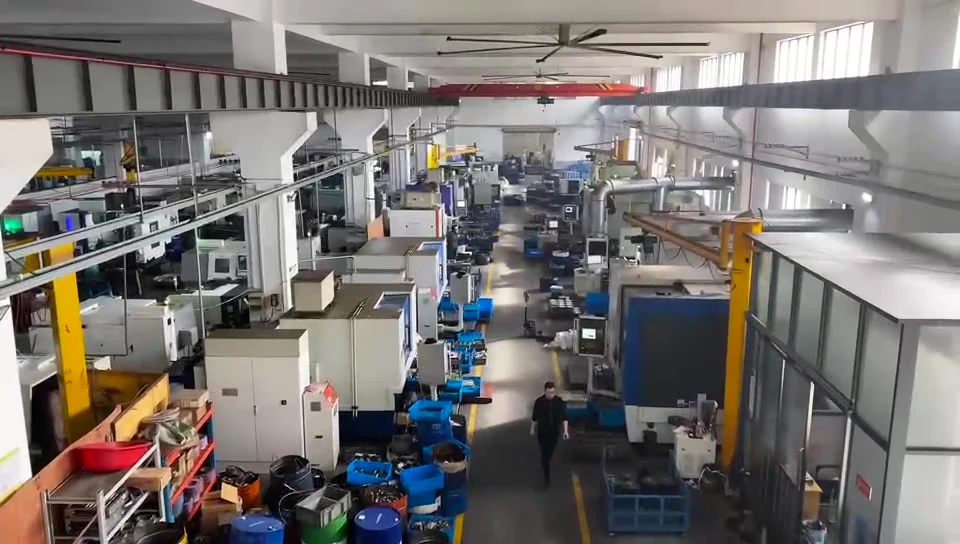
Inside the workshop
A view of the workshop. Product configuration is reviewed against your machine and application.
READY FOR A TECHNICAL REVIEW?
Send your nameplate, get a mounting review within one business day.
Or message us directly